
Final Expense Insurance Waiting Period: What Gets Paid?
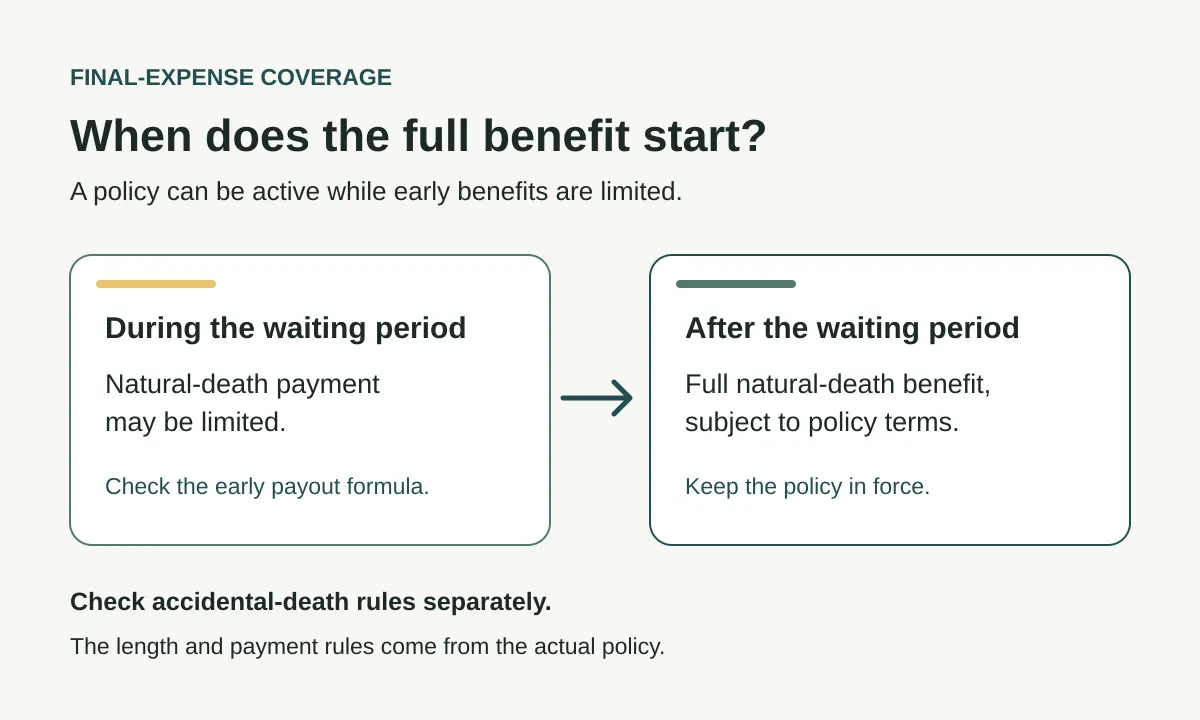
A final expense insurance waiting period limits what a policy pays for certain deaths soon after coverage starts. A two-year period is common in guaranteed-issue coverage, but the length and early payment rules depend on the policy. Some policies offer full benefits from the coverage start date. The key question is what your beneficiary receives before the full benefit begins—not simply whether the policy is active.
What is a final expense insurance waiting period?
A waiting period is an initial stretch of time when certain death benefits are limited. The death benefit is the money paid to the beneficiary—the person you name to receive it—when the policy's conditions are met.
You may see the terms “graded death benefit” or “modified death benefit.” These describe early benefit limits, but the labels alone don't tell you the payout formula. A policy may pay back premiums with an added percentage, or pay part of the stated coverage amount.
The Florida Department of Financial Services' life insurance consumer guide explains that graded-benefit coverage pays a smaller amount for non-accidental deaths in the first few years. Its guide, revised in 2017, also describes separate accidental-death benefits. Your policy's benefit schedule supplies the exact amounts and dates.
What gets paid during the first two years?
Read the natural-death and accidental-death terms separately. Natural death generally means death from illness or disease; an accidental-death benefit uses the policy's own definition of a covered accident.
| Policy terms to look for | During the initial period | After the period ends |
|---|---|---|
| Full benefit from the start, sometimes called a level benefit | Stated death benefit for a covered death, subject to exclusions and other terms | Stated death benefit, subject to policy terms |
| Early payment based on premiums | The specified premium amount plus any stated addition for a covered non-accidental death | Full stated benefit for a covered death |
| Early payment based on a percentage of coverage | The percentage listed for that policy year and cause of death | Full stated benefit for a covered death |
For a concrete carrier example, Gerber Life's Guaranteed Life Insurance FAQ, checked in November 2026, describes 110% of earned premiums for non-accidental death during its first two years. It lists a one-year graded period in North Dakota and separate suicide terms. This is an example of published carrier terms, not an offer from JCA Venture Group.
“Earned premiums” means premiums attributable to coverage already provided. If you've prepaid, don't assume every dollar you've sent is included in that amount.
A $10,000 coverage amount may mean a much smaller early payment
Here is a hypothetical calculation using a two-year waiting period and an early natural-death benefit of 110% of earned premiums. Assume a $10,000 coverage amount, a $50 monthly premium, 12 full monthly premiums earned, and no policy debt or other adjustments. These amounts demonstrate the arithmetic; they are not a price quote.
- Earned premiums after 12 months: 12 × $50 = $600.
- Early natural-death payment: $600 × 1.10 = $660.
- After the two-year period, a covered death would instead have the $10,000 stated benefit, assuming the policy remains in force and its conditions are met.
The extra 10% is calculated on $600, not on $10,000. That difference matters if you're counting on coverage to pay a specific bill during the first two years.
Does accidental death bypass the waiting period?
Some graded-benefit policies pay the full stated benefit for a covered accidental death during the waiting period. That doesn't make every sudden death an accident. A heart attack can happen suddenly but still be a natural death.
Ask for the accidental-death definition and exclusions in writing. Also check whether the contract sets a deadline between the accident and death. Use the policy wording rather than assuming that every fall or injury qualifies.
Is a waiting period the same as contestability?
No. A graded-benefit waiting period sets the early payment amount. A contestability period allows the insurer to challenge a policy based on material misrepresentations—incorrect application information that affected its decision to issue coverage.
The North Carolina Department of Insurance's life insurance FAQs, checked in November 2026, explain that policies may be voided within the first two years when incorrect answers affected the insurer's decision. The department separately describes a two-year suicide limitation and notes that the state of issue governs the applicable rules.
A policy advertised as having “no waiting period” can still have contestability provisions and exclusions. Review the completed application for accuracy before signing.
Check these five items before choosing a policy
- Start date and end date. When does coverage become effective, and on what exact date does the early benefit limit end?
- Natural-death payment. What formula applies in each early policy year? Ask for a dollar example using the proposed premium.
- Accidental-death payment. What qualifies, what is excluded, and what timing requirements apply?
- Full benefit and ongoing payments. What is the stated benefit afterward, and what payments keep the policy in force?
- Other early restrictions. Where are the contestability and suicide provisions written?
No medical exam doesn't automatically mean no waiting period. Health questions and other underwriting—the insurer's eligibility and terms review—may still apply. See our coverage basics and policy-type comparison for those distinctions.
JCA Venture Group's free printable policy-comparison worksheet has space to record the waiting period and early natural- and accidental-death benefits for two written offers. You can print it without an account or contact details.
For your own policy, ask the issuing insurer or a licensed agent to confirm the benefit schedule and exclusions in writing before you decide.